Before this year’s summer break, new energy was injected into the debate on how to reform the EU enlargement process to make it better suited to deliver results – and to do so swiftly. Four documents emerged at the EU level in May and June: Chancellor Merz’s proposal for associated membership for Ukraine; Franco-German non-paper; Netherlands-led non-paper on post-accession safeguards; and Friends of the Western Balkans non-paper on advancing gradual integration.
The proposals acknowledge that both the geopolitical and security landscape and the European Union itself have changed significantly since the last big enlargement wave, and that the enlargement process needs to reflect these new realities. They put forward different ideas on how to dynamise and accelerate the process, while ensuring better preparedness of acceding countries and strengthening the Union internally.
Most of the proposals follow the logic of integration before membership, advancing gradual integration into EU policies (including the Single Market), institutions and funds, or proposing new forms of partial membership, such as “associated membership” for Ukraine. The Netherlands-led proposal, meanwhile, focuses primarily on safeguarding the rule of law and the EU’s decision-making capacity after enlargement.
Taken together, the proposals are an important signal of how far the enlargement debate has shifted in recent years: from “if”, to “when”, and increasingly to “how”. They put forward a number of interesting ideas that could help bring candidate countries into the EU faster.
However, if the incentives offered through gradual integration or forms of temporarily limited membership are to deliver meaningful and lasting alignment with the EU’s standards, norms and values, and ultimately strengthen rather than weaken the Union, it is crucial to define how democratic and rule of law conditionality will work in practice.
This analysis therefore looks specifically at the conditionality mechanisms outlined in the four proposals, identifying their strengths, gaps and potential weaknesses and examining their implications for strengthening democracy and the rule of law in candidate countries. You can read the full analysis on CRTA.Plus or download the PDF format here.
Summary of main findings:
- The proposals offer important ideas for accelerating accession and making integration more tangible before membership. Yet from the perspective of democracy and the rule of law, significant gaps remain. Most proposals are considerably more specific about the benefits candidates could receive than about the democratic conditions attached to them, how compliance would be assessed, and what consequences would apply in cases of backsliding.
- Reversibility needs to become operational, not merely declaratory. Several proposals recognise that gradual integration benefits should be reversible in cases of backsliding. However, more elaboration is needed to define what constitutes backsliding, which benchmarks should be used, who should assess compliance, or what would automatically trigger suspension or withdrawal of benefits. Effective gradual integration requires clear and measurable democratic and rule of law benchmarks, regular monitoring and consequences that can be activated swiftly when those conditions are no longer met.
- Democratic and rule of law conditionality must be maintained and applied efficiently as integration advances. Giving candidates substantial access to the Single Market, EU programmes, funding or even institutions before accession can provide powerful incentives and contribute to their deeper integration into the EU. But as more membership benefits are granted early, it becomes increasingly important to preserve sufficient leverage for the remainder of the accession process – in the form of strict scrutiny and rigid conditionality. Financial conditionality and credible withdrawal mechanisms should therefore accompany gradual integration.
- Sectoral integration cannot be reduced to technical acquis compliance. Access to parts of the Single Market should not depend solely on meeting technical requirements within individual negotiating chapters. Deeper integration requires trust in candidates’ legal and political systems and should therefore be linked horizontally to progress on the rule of law, democratic governance and other fundamentals. Alignment with the EU’s CFSP is also necessary for protecting the integrity and resilience of an increasingly integrated Union.
- Acceleration must not mean a return to a technocratic enlargement process. Efforts to remove procedural obstacles and accelerate the opening of negotiating clusters should not override the fundamentals-first logic of the revised enlargement methodology. Technical fulfilment of benchmarks cannot compensate for broader democratic deterioration. Documented backsliding should have tangible consequences for progress and for access to benefits of gradual integration.
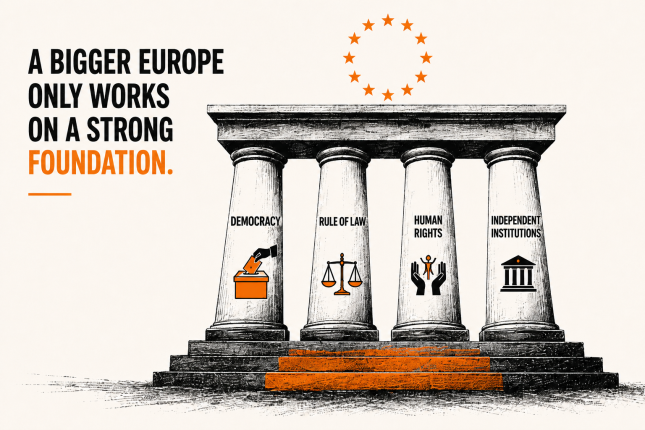
- Conditionality cannot end with accession. The EU’s experience demonstrates the need for stronger mechanisms to prevent and address democratic and rule of law backsliding once membership has been achieved. Post-accession monitoring, non-regression requirements and effective safeguard mechanisms should therefore form part of the discussion about the next enlargement.
- At the same time, post-accession safeguards should not create a two-tier Union in which new members are subject to significantly stricter democratic scrutiny than existing ones. Strengthening conditionality for future members must go hand in hand with strengthening the EU’s rule of law toolbox as a whole. Effective monitoring and enforceable consequences for violations of EU fundamental values should apply consistently to all Member States.
- The objective should therefore be continuous democratic conditionality before, during and after accession. Enlargement needs to accelerate after years of stagnation, but not by lowering democratic and rule of law standards. On the contrary, greater flexibility and earlier integration require stronger safeguards to ensure that enlargement retains its transformative power and ultimately strengthens rather than weakens the Union.