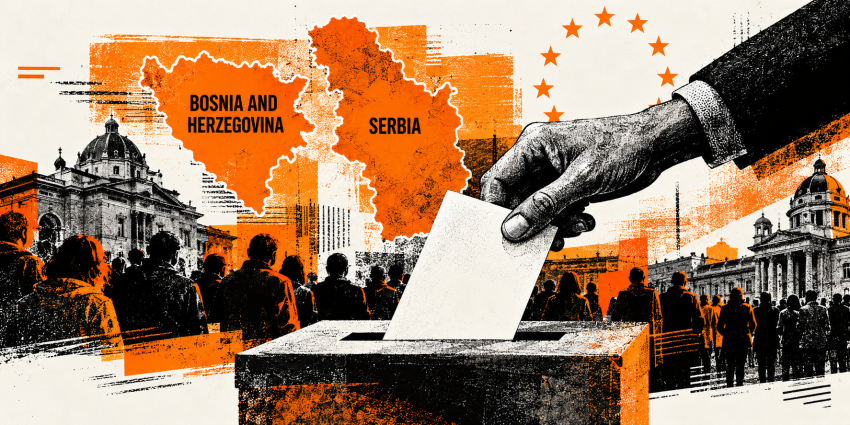
Ahead of general elections in Bosnia and Herzegovina and Serbia, EUCRTA brought together election experts from the two countries and the wider European election observation community to discuss electoral integrity, emerging risks and the role of the EU. Despite differences between the two countries, the discussion highlighted a common lesson: protecting elections requires looking well beyond election day – at institutions, media, political finance violations, voter pressure, misuse of public resources and the broader state of democracy.
The recording of the discussion is available on the EUCRTA YouTube channel here.
The discussion, organised as part of EUCRTA’s Western Balkans in Focus series, featured Rasa Nedeljkov, Program Director at CRTA; Dario Jovanovic, Project Manager at the Centers for Civic Initiatives and the Coalition for Free and Fair Elections “Pod lupom”; and Vardine Grigoryan, Board Member of the European Platform for Democratic Elections (EPDE) and Program Manager at the Helsinki Citizens’ Assembly – Vanadzor.
Bosnia and Herzegovina: technology can protect election day, but cannot fix state capture
The upcoming general elections in Bosnia and Herzegovina will be the first held under a substantially revised electoral framework following amendments imposed by High Representative Christian Schmidt.
Dario Jovanovic highlighted three major changes: electronic voter identification, ballot scanners and redesign of the ballot. The new technologies should make several forms of manipulation documented in previous elections significantly more difficult – including voting on behalf of absent or deceased voters, misuse of unused ballots, deliberate invalidation of ballots and manipulation of preferential votes during counting.
The technological changes are accompanied by other reforms, including changes to polling station committees and stricter rules concerning misuse of state resources, early campaigning and other electoral violations.
However, as Jovanovic stressed, new election technologies will fix the election day – they will not fix systemic corruption and state capture. As opportunities for manipulation at polling stations decrease, pressure may increasingly move into the pre-election period. Pod lupom is already documenting widespread problems including misuse of public resources and different forms of voter pressure.
Implementation also remains a challenge. In particular, the redesigned ballot was introduced only relatively shortly before the elections, leaving limited time for voter education. While the new ballot itself may be simpler, unfamiliarity with it could confuse voters or contribute to invalid ballots.
Foreign political influence adds another dimension. Political actors from neighbouring Serbia and Croatia remain closely engaged with particular political forces in Bosnia and Herzegovina, while the legacy of overlapping citizenship and voter-registration arrangements across the former Yugoslav region continues to raise electoral integrity questions.
Serbia: elections amid civic mobilisation and deteriorating electoral conditions
Serbia enters its elections after almost two years of student-led protests and wide civic mobilisation triggered by the November 2024 collapse of the canopy at Novi Sad railway station. Rasa Nedeljkov emphasised that this mobilisation has changed Serbian society, bringing a new group of citizens, particularly young people, to the forefront of demands for accountability, transparency and the rule of law.
At the same time, CRTA’s observation of recent local elections points to worsening trends in several areas essential for free and fair elections. Among the most serious concerns are electoral violence, impunity for electoral offences, involvement of groups linked to organised crime, misuse of state institutions, severe media imbalance and weak electoral oversight.
The integrity of the unified voter register also remains an important issue following controversies surrounding the 2023 elections. The subsequent adoption of legislation allowing an audit of the register represents progress, but its significance will depend on meaningful implementation and on the audit commission’s access to the necessary data.
The media environment represents another major concern. Nedeljkov pointed to an overwhelming imbalance in political representation on major broadcasters and problems surrounding the functioning of Serbia’s media regulator (REM). Weaknesses in electoral administration and the limited effectiveness of other oversight institutions further reduce their ability to address abuses during the campaign.
Although some electoral amendments have been adopted, the discussion highlighted a persistent gap between formal legislative changes and meaningful reforms addressing the structural problems identified by domestic observers and ODIHR.
An additional source of uncertainty is Serbia’s electoral calendar. Potentially overlapping presidential, parliamentary, local and National Minority Council elections could create a prolonged electoral period, while the possibility of repeated voting at individual polling stations could delay the formal conclusion of a close contest.
A broader trend: electoral manipulation adapts
Drawing on experiences from Armenia and EPDE’s wider network, Vardine Grigoryan highlighted that many of the challenges discussed are not unique to the Western Balkans.
A broader pattern is emerging in which electoral manipulation adapts to the safeguards available. Where manipulation of voting and counting remains possible, efforts may concentrate on election day. Once technology and stricter procedures close these opportunities, pressure can shift towards vote buying, voter intimidation, campaign finance violations, misuse of administrative resources, and manipulation of the information environment.
Experiences from Armenia, as well as developments observed elsewhere in Europe, demonstrate why technological improvements alone cannot guarantee electoral integrity. Better voter registers and identification mechanisms can close particular avenues for fraud, but new vulnerabilities continue to emerge, including foreign information manipulation and interference.
Ultimately, Grigoryan stressed, electoral integrity comes down to a fundamental guarantee for every citizen: voters must know that their vote is secret, that they can make their choice freely, and that their vote will be counted as cast.
What role for the EU and international community?
The discussion underscored the importance of the EU as the key actor in strengthening electoral integrity in candidate countries and the wider neighbourhood through political conditionality, financial support, international election observation and sustained support for domestic election observers.
In Serbia, international pressure has contributed to concrete developments, including legislation concerning the unified voter register and its audit. However, the speakers stressed that attention needs to remain focused on implementation rather than the formal adoption of legislation. Reforms that address secondary issues while leaving structural problems untouched cannot substantially improve electoral conditions.
Domestic election observers are particularly important in this respect. Unlike international missions deployed around elections, domestic organisations work continuously between electoral cycles, possess detailed knowledge of national electoral practices and can follow whether recommendations are actually implemented.
The discussion also highlighted the importance of sustained international attention throughout the entire electoral cycle, rather than engagement concentrated primarily around election day. International observation missions remain essential, but many of the most consequential problems develop long before voters enter polling stations – from voter pressure and misuse of state resources to media imbalances, weaknesses in voter registers and failures to implement previous recommendations.
International partners should therefore combine election-day observation with longer-term scrutiny of the pre-election environment and systematic follow-up after elections, including pressure for identified irregularities to be investigated and recommendations to translate into meaningful reforms. This continuous engagement is particularly important as electoral manipulation adapts and increasingly shifts away from practices that can be easily detected on election day.
Finally, EU engagement should not stop with governments. As Nedeljkov stressed in relation to Serbia, democratic partners should engage with the wider society – including civil society, young people, journalists and citizens demanding democracy and the rule of law. Electoral integrity ultimately depends not only on electoral rules, but also on strong institutions and citizens capable of holding those institutions accountable.