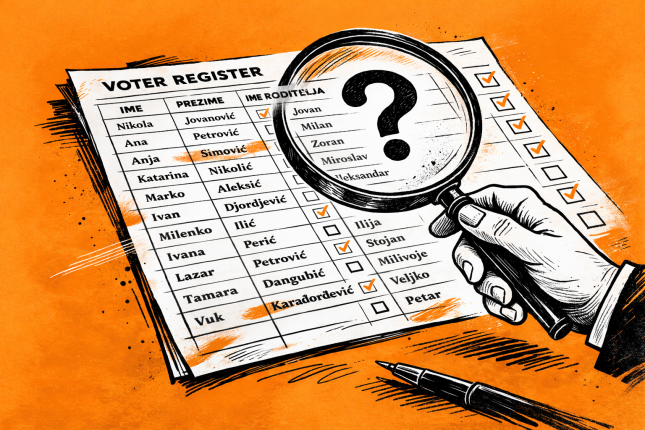
The Unified Voter Register (UVR) represents one of the core pillars of electoral integrity in Serbia. Functioning as the official database of all citizens eligible to vote, it has a direct effect on the credibility of every election process. An accurate, transparent, and regularly updated voter list is a prerequisite for any free and fair elections and for restoring public trust and confidence in democratic institutions within the country.
For years, domestic and international election observers have recommended a comprehensive revision of the voter register in Serbia, pointing out recurring irregularities and structural weaknesses of the current register. The issue became particularly important after the December 2023 elections, when domestic election observers and opposition parties raised concerns about illegal voter migrations and manipulation of the voter register (including voting on behalf of deceased, absent, or inactive voters, changing voters’ addresses to enable them to vote where politically needed, granting citizenship and residence in order to relocate voters, and unauthorized interventions in the voter register’s software). These allegations have significantly undermined public trust and reinforced the perception that the voter register can be used as a political instrument by those in power, rather than as a nonpartisan administrative database.
A meaningful audit of the Unified Voter Register is also included among the priorities of Serbia’s Reform Agenda, as a crucial step toward advancing on the EU accession path. In accordance with this commitment, albeit with a significant delay, the National Assembly of Serbia adopted amendments to the Law on the Unified Voter Register in November 2025. Among other provisions, the amendments established a Commission tasked with conducting a comprehensive review, verification, and oversight of the accuracy of the voter register and its regular updating.
The Commission: Explained
The Commission for the Audit, Verification and Control of the Accuracy and Updating of the Voter List was formally established on 4 February 2026, envisioned to function as an independent body composed of ten members and their respective deputies. Eight members are appointed by parliamentary groups, while two members and their deputies are nominated by civil society organizations recognized by the Republic Electoral Commission and having observed at least three election processes. The current composition of the Commission includes 5 representatives of the ruling majority, 3 representatives of opposition parties, and 2 representatives of civil society organizations, both with extensive experience in election monitoring (CRTA and CeSID). Decisions within the Commission are to be adopted by a majority of seven votes, with the additional requirement that at least two votes must come from each group, a mechanism designed to ensure cross-political consensus and prevent unilateral decision-making.
Obstacles already?
The new Law on the Unified Voter Register legally allows the Commission to access all databases and records relevant to the voter register. Under the law, the Commission is authorised to analyze data, identify inaccuracies, order the correction of irregularities, initiate proceedings against those responsible for violations of the law, conduct field checks in cooperation with the Ministry of Interior, and decide on citizens’ submissions. To ensure the proper functioning of the Commission, specific implementation deadlines have been established – 15 February 2026 for the publication of voter lists by polling stations with full names, and 15 May 2026 for the publication of data on the number of voters registered to a household.
However, the first deadline was not met within the prescribed timeframe. The Ministry of Public Administration and Local Self-Government initially denied the request to publish the promised data, despite the clear legal obligation. Only after sustained pressure from independent media and civil society organizations involved in monitoring the UVR process did the Ministry, on 24 February 2026, publish the voter register containing first name, last name, and the name of one parent. This early delay and initial refusal to comply illustrate the very obstacle the Commission is expected to confront, raising concerns about the level of institutional cooperation and the practical implementation of the new legal framework.
In theory vs Reality
If the Commission performs its mandate in accordance with the law, several important outcomes can be expected:
- Provide a clear and factual picture of the state of the voter register, including identified deficiencies, irregular entries, and potential surpluses;
- Reveal systemic failures that contribute to the register’s inaccuracy and allow outdated data to persist;
- Shed light on the concrete mechanisms and institutional positions through which abuses occur.
The ultimate aim of the Commission’s work is to ensure a precise and abuse-proofed voter register, thereby safeguarding the equal voting rights of all citizens and strengthening the legitimacy of election results.
However, experience has shown that the core problem in Serbia lies not in the absence of legal provisions, but the persistent failure to implement long-standing electoral recommendations due to a lack of political will. The effectiveness of the Commission therefore depends not only on its formal powers but also on genuine cooperation from state institutions, particularly the competent ministries, and on the timely provision of complete and unrestricted access to all relevant data (which is already being questioned with the failure to meet the February 15 deadline). Without such cooperation, there is a significant risk that the Commission’s mandate will remain formally intact while being undermined in practice through excessive procedural requirements, selective access to information, or delayed responses from responsible authorities. In such circumstances, partial or merely symbolic measures may be presented as reform, without delivering meaningful structural change.
The establishment of the Commission represents an important opportunity to address one of the most sensitive and persistent issues in Serbia’s electoral framework. However, its success will be measured not by its formal creation but by its ability to deliver tangible results: a comprehensive and evidence-based assessment of the UVR, the correction of identified irregularities, and the introduction of safeguards to prevent future abuse.
With upcoming elections in the near future, the audit of the Unified Voter Register is not merely a long-term objective, but an urgent and non-negotiable precondition for restoring basic electoral integrity. Without a credible and thoroughly verified voter register, any future electoral process risks being overshadowed by doubt and the current crisis of trust. This is not merely a technical requirement; it is a fundamental democratic guarantee, ensuring that every vote is cast and counted under equal and fair conditions.