
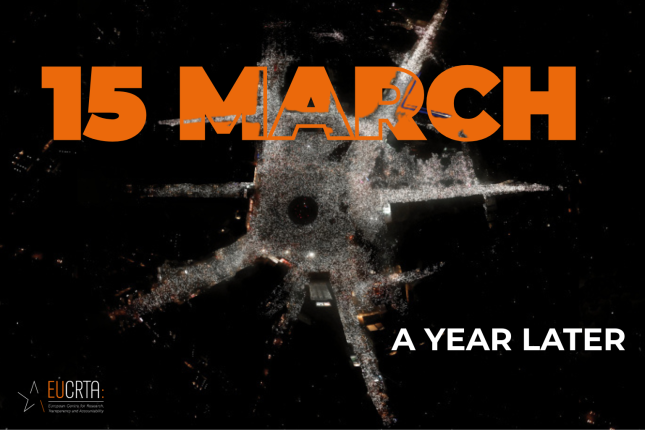
On 15 March 2025, the largest protest in Serbia’s history took place. It served as the culmination of the ongoing student-led protests, seeking justice for the 16 victims of the Novi Sad railway station canopy collapse on 1 November 2024. More than 300,000 citizens answered the call and filled the streets of Belgrade demanding accountability.
The protests, which began in Novi Sad as a means of fight for justice, and later spread to Kragujevac and Niš, were largely peaceful and symbolically centered around University cities across the country. Students had organised long-distance marches between cities, engaging with and mobilising local communities along the way, transforming years of dissatisfaction with government policies into a nationwide civic movement. By mid-March, the anticipated Belgrade protest was widely perceived as a defining political moment, a test of democratic resilience and the government’s response to growing public pressure.
At 19:11, during the now customary 16 minutes of silence held to commemorate the victims, the atmosphere shifted dramatically. People began to disperse abruptly, many describing confusion, fear and physical discomfort. Panic spread through the crowd. Following the events, an analysis of the situation was conducted by the investigative group Earshot, gathering more than 3,000 testimonies reporting an intense and unfamiliar sound cutting through the crowd. Allegations quickly emerged that a directional acoustic device commonly referred to as a “sonic weapon” had been deployed during the gathering, which the government officials quickly denied.
Immediate officials’ denials and contradictory statements
In addition to the President of Serbia, the use of prohibited weapons was also denied by the Ministry of the Interior (MUP), the Ministry of Defense, the Gendarmerie and the Security Information Agency (BIA), although they provided contradictory information.
Ivica Dačić, Serbia’s Minister of the Interior, initially stated that the police forces did not possess such devices. In the days following the protest, photographs circulated online, showing what appeared to be a device mounted on a police vehicle positioned near the National Assembly on the evening of 15 March. Minister Dačić first claimed that the devices were stored and not mounted, later revising his account and stating that the equipment visible was merely a loudspeaker intended for public communication. Subsequently, he acknowledged that his initial statement had been “clumsy,” admitting that sonic devices had indeed been purchased in 2021.
Authorities also denied possessing other models, including the LRAD 1000Xi, and rejected claims involving devices such as the “Vortex Ring Gun” or “Vortex Cannon.” Nevertheless, the evolving nature of official explanations contributed to public skepticism and raised questions about transparency and institutional accountability.
Independent investigation and the Earshot report
In the aftermath of the alleged sonic attack on protestors, Earshot has carried out a comprehensive analysis of the audio content of 19 videos, conducted 15 in-depth earwitness interviews with protestors positioned along the Kralja Milana Boulevard, and aggregated more than 3,000 written statements from the protest attendees. Their analysis and collected evidence suggest a high probability that protestors were subjected to a targeted attack using a directional acoustic weapon. Findings of the investigation stand in direct contrast to the claims made by the Federal Security Service (FSB) of the Russian Federation and Serbian authorities, which suggested that the disturbances may have been caused by fireworks or by a sound generated within the crowd itself.
As stated in the report: ‘witnesses consistently described the sound as unfamiliar and unlike any common urban noise. Many who gave statements, 2,335 to be precise, stated that they had experienced both an auditory and physical sensation, describing it as something that “passed through” them or was felt “from within.”’
Notably, all 15 interviewed respondents independently identified the same three sound samples from a library of more than 26 audio clips presented during the investigation. Additional 1,907 written statements described sounds closely matching those same three samples. Based on this consistency, Earshot reconstructed an approximate version of the sound and made it publicly available.
The continuation of repression and democratic implications
One year later, the events of 15 March 2025 remain a crossroads between official denial and calls for accountability. On the one hand, state institutions have categorically rejected the allegations. On the other, an independent investigation points to a high probability of directed acoustic exposure. The issue extends beyond technical debates over decibel levels or specific device models. At its core, it raises broader questions about fundamental rights and democratic governance: the right to peaceful assembly, the obligation of the state to ensure the safety of its citizens and the need for transparency in institutional conduct.
The protest itself represented more than a mass gathering. It represented collective mourning, civic mobilisation and a demand for accountability. The alleged use of a sonic weapon during a moment of silence transformed it into something more consequential – a symbol of the fragile relationship between citizens and the state. Minister Dačić himself publicly stated that the use of a “sound cannon” would not be in accordance with existing legal provisions. Beyond domestic legislation, Serbia is also bound by international human rights standards, including obligations arising from the European Convention on Human Rights, which protects the freedom of peaceful assembly and prohibits inhuman or degrading treatment.
The controversy surrounding the events of 15 March also reflects a broader pattern – the erosion of public trust. This erosion stems not only from the allegations themselves but from the perceived lack of clear and transparent institutional responses.
For Serbia, particularly in the context of its European integration process, this case represents an important test of its commitment to the rule of law. Ultimately, the central question is not solely whether a sonic device was used, but whether credible, independent and transparent mechanisms exist to determine the truth when serious allegations arise.